
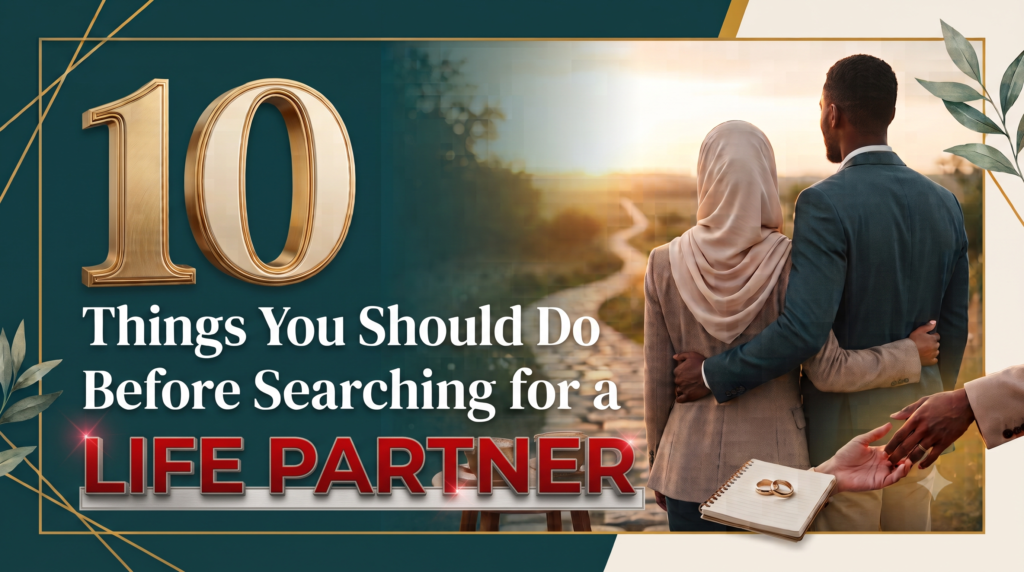

In Pakistan, the conversation about marriage rarely starts with the individual. It starts with the family. Suddenly, relatives are asking questions at weddings, your mother is mentioning a cousin of a neighbour’s friend, and before you have thought seriously about what you actually want from a marriage — the Rishta process has already begun.
This is exactly where so many people get into trouble.
Finding the right life partner has less to do with how many profiles you see or how quickly your family moves, and much more to do with how well you know yourself before the search begins. The most successful marriages — the ones that are genuinely happy, not just socially acceptable — tend to start with two people who did their own inner work first.
These are the ten things you should do before you start seriously searching for a life partner. Whether you are about to enter the formal Rishta process, considering a matrimonial platform, or simply wondering if you are ready — this guide is honest, practical, and built for the Pakistani context.
1. Understand Yourself Before You Try to Understand Someone Else
Most people enter the marriage search knowing exactly what they want in a partner but with very little honest understanding of who they actually are. They can list a potential spouse’s desired qualities in seconds — educated, family-oriented, settled, kind, religious — but struggle to answer basic questions about themselves.
Before you look outward, look inward. What are your actual values, not the ones your family expects you to have? What kind of life genuinely makes you happy, separate from social approval? What are your real emotional triggers, and how do you respond under pressure? What aspects of yourself are you still trying to improve?
Self-awareness is not self-criticism. It is simply the honest inventory that prevents you from choosing a partner based on surface attraction or family pressure, and helps you instead choose someone who actually fits who you are and where you are going.
A practical exercise: write down five things that are non-negotiable in your life — not in your partner, in your own life. Your faith, your career direction, where you want to live, your relationship with your family. Then ask whether the kind of person you are looking for is genuinely compatible with those five things, or whether you are looking for a fantasy.
2. Heal From Whatever Came Before
This applies whether you have been in a previous relationship, have experienced a painful Rishta rejection, or are carrying unresolved hurt from your own family dynamics. Unhealed emotional wounds do not stay invisible after marriage. They come into the relationship with you, and they tend to surface at the worst possible moments.
Healing does not mean you must be perfectly happy and problem-free before you can find a partner. Nobody is. It means you have processed your past enough to understand it, rather than being silently driven by it.
In the Pakistani context, many people have never had the space to talk about past emotional hurt — whether from a failed Rishta, family conflict, or loss. If professional counselling feels too formal, at minimum give yourself honest time and reflection before entering a new search. A marriage entered with unprocessed pain becomes a place where that pain gets worked out — and that is not fair to you or your future spouse.
3. Be Truthful About Your True Desires
This is harder than it sounds. There is what your family wants for you. There is what society expects. There is what looks good on paper. And then there is what you genuinely need in a life partner to be content ten years from now.
These four things are often very different from each other.
Take time to be honest with yourself about the basics: do you want children, and if so, how many and when? Do you want to live in the same city as your parents or independently? Do you want a spouse who works, or do you prefer a more traditional arrangement? What role do you want your in-laws to play in your daily life?
These are not trivial questions. They are the exact points where many Pakistani marriages experience their first serious friction — not because the couple was incompatible in character, but because they had never explicitly discussed expectations that seemed too obvious to mention. Define what you want clearly in your own mind first, so that when the right person comes along, you can recognise them honestly rather than convincing yourself they fit when they do not.
4. Get Your Finances in Order
You do not need to be wealthy before you get married. But you do need to be financially responsible. In Pakistan, financial stress is one of the leading causes of marital conflict — and it hits hardest in the first two years of marriage, when a couple is navigating new responsibilities together for the first time.
Financial responsibility means different things for men and women in the Pakistani context, and it is worth being honest about both. For men, it means having a reliable income, understanding your actual expenses, and being honest — with yourself and a potential spouse — about your financial situation rather than inflating it to impress a family. For women, it increasingly also means having a clear understanding of your own financial rights within a marriage, including Mehr and your entitlement to Nafaqa under Islamic law.
Before your Rishta search begins, have an honest look at your finances. Do you have savings? Are you managing debt responsibly? Do you have a plan for how you and a future spouse would handle household expenses? These conversations will happen eventually — having thought about them beforehand puts you in a far stronger position.
5. Learn How to Communicate Honestly
Most people believe they are good communicators. Most people are wrong — at least when it comes to the kind of communication that marriage actually requires.
Communication in a marriage is not just talking. It is the ability to say something difficult without becoming cruel. It is listening to understand, not listening to respond. It is expressing your own needs without making the other person feel attacked. It is knowing when to push through a disagreement and when to let something go.
In Pakistani families, many people grow up in households where difficult things simply are not said. Conflict is avoided, feelings are managed indirectly, and honesty is sometimes sacrificed for peace. These habits, carried into a marriage, create exactly the kind of slow-burning resentment that destroys relationships over years.
Before your marriage search begins, practice honest communication in your existing relationships — with your parents, your siblings, your friends. It is a skill that must be built before you need it, not after.
6. Develop Emotional Maturity
Emotional maturity is one of the most important — and most undervalued — qualities in a future spouse, and one of the most important qualities to develop in yourself.
It means taking responsibility for your own emotions instead of blaming others for how you feel. It means being able to say “I was wrong” without it feeling like a defeat. It means recognising when you are angry and choosing your response rather than reacting instantly. It means having empathy — the genuine ability to understand how another person feels even when their experience is different from yours.
Emotional immaturity in a marriage does not stay hidden. It shows up every time there is a disagreement, every time plans change unexpectedly, every time one partner needs support the other is not equipped to give. The investment you make in your own emotional development before marriage pays lifelong dividends in the relationship itself.
7. Build a Life That Makes You Happy on Its Own
One of the most common and most painful mistakes people make before marriage is treating a future spouse as the solution to an unhappy life. If you are lonely, you look for a partner to solve loneliness. If you are bored, you look for a relationship to provide excitement. If you are lost, you look for someone to give you direction.
The problem is that this puts an impossible weight on another person — and it also means you are making a lifelong decision from a place of need rather than a place of genuine desire.
Before you search for a life partner, build a life you genuinely enjoy. Invest in friendships. Develop skills and hobbies that engage you. Work toward career or personal goals that give you a sense of purpose. Establish daily habits and routines that support your wellbeing.
When you are content and purposeful in your own life, you choose a partner from a position of abundance rather than desperation. That single shift changes everything about the quality of the search and the quality of the relationship that follows.
8. Know Your Non-Negotiables — And Your Negotiables
Before any Rishta process begins, sit down and be honest with yourself about two lists. The first: your absolute non-negotiables. The values, behaviours, and circumstances that you know, from honest self-knowledge, would make a marriage impossible or deeply unhappy. For most people, this list is shorter than they think — perhaps five to seven things at most.
The second list: your preferences. Things you would like but that are not dealbreakers. Height. Profession. City of origin. Specific degree. These are preferences, and preferences are negotiable.
The clarity between these two categories is enormously important. Many Rishtas fail because someone said no to a genuinely compatible person over a preference they treated as a non-negotiable. Many marriages fail because someone said yes despite a real non-negotiable they dismissed in the excitement of the moment.
Write both lists. Revisit them. Be honest about which is which.
9. Learn What Healthy Relationships Actually Look Like
Many Pakistanis have never seen a truly healthy marriage up close. What we observe in our families, our extended circles, and in media is often a mixture of love, sacrifice, compromise, unspoken resentment, and performance. We absorb these patterns without realising it, and then recreate them in our own relationships.
Before you search for a life partner, invest time in understanding what a genuinely healthy relationship looks like. Read books written by credible relationship psychologists. Seek out couples — in your circle or through content you consume — who model the kind of partnership you want, not just the surface appearance of it.
A healthy marriage is not conflict-free. It is not effortless. It is two people who have both done enough inner work to handle disagreement with respect, to grow through difficulty without giving up, and to choose each other actively rather than out of habit or obligation.
10. Be Patient With the Process — And With Yourself
In Pakistan, the social pressure to marry by a certain age is real, relentless, and for many people, genuinely distressing. Relatives make comments. Parents worry. Weddings of peers feel like quiet indictments of your own timeline. The pressure to find someone — anyone — can become louder than the voice asking whether the right person has actually arrived.
Patience in this context is not passive. It is an active choice to protect the quality of one of the most important decisions of your life from the distortion of social pressure.
The best marriages are rarely the fastest ones. They are the ones where both people took enough time to know themselves, to know each other, and to build the foundation honestly rather than quickly. Taking an extra year to do this work is not a failure. It is wisdom.
Final Thoughts
The search for a life partner does not begin when you start looking at profiles or attending Rishta meetings. It begins with the work you do on yourself — your self-awareness, your emotional health, your values, your communication, your patience.
ZUFUF was built on exactly this belief: that the most important part of matchmaking is not the algorithm or the number of profiles — it is the depth of understanding you bring of yourself, and the depth of care taken in understanding the other person. A psychologist-built profile, a verified identity, and a curated match process are tools in service of something much larger: a marriage built on honesty, compatibility, and genuine readiness.
Ask yourself not just “where do I find the right person?” but “have I done the work to be ready for them when they arrive?”
Frequently Asked Questions
How do I know if I am emotionally ready for marriage?
You are likely emotionally ready when you can manage your own emotions without consistently projecting them onto others, when you can take accountability in a disagreement rather than only defending yourself, when you feel genuinely content in your own life and are looking for a partner to complement it rather than complete it, and when your desire to marry comes from a genuine place rather than from family pressure or fear of being left behind.
What is the most important quality to develop before searching for a life partner?
Self-awareness is the foundation. Without an honest understanding of your own values, triggers, needs, and non-negotiables, every other quality — communication, emotional maturity, financial responsibility — is harder to develop and harder to use effectively in a relationship.
In Pakistan, how do I balance family expectations with my own readiness?
This is one of the most common and genuinely difficult challenges Pakistani young adults face. The most effective approach is to have direct, honest conversations with your family about your own readiness and your specific needs in a partner before the Rishta process begins — not during it. When families understand what you are looking for and why, they become allies in the search rather than sources of pressure.
Can a Rishta work if both people are very different?
Differences in personality, background, and even some values can be navigated successfully in a marriage when both people share core non-negotiables, communicate openly, and genuinely respect each other’s differences. What tends to be more challenging is differences in fundamental values — regarding faith, family roles, children, and lifestyle — where compromise is genuinely difficult without one person consistently sacrificing something central to who they are.
